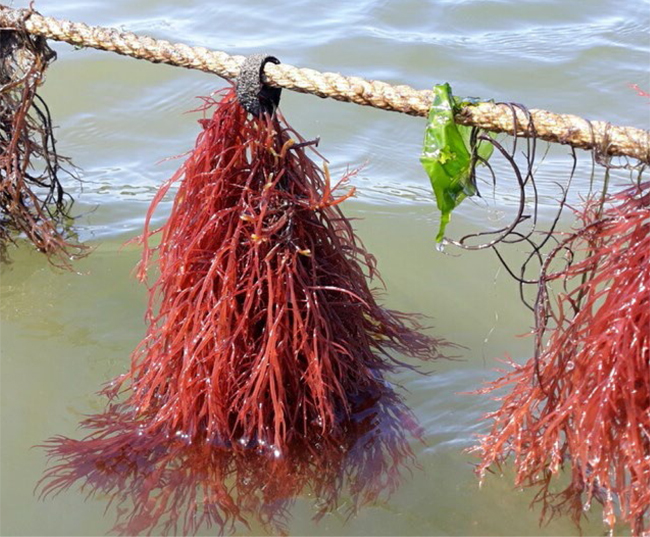
Agardhiella subulata grown on a line in Mount Sinai Harbor, Long Island. Credit: Christopher Gobler
— By Chris Gonzales, Freelance Writer, New York Sea Grant
Contact:
Lane Smith, Research Program Coordinator, NYSG, E: lane.smith@stonybrook.edu, P: (631) 632-9780
Scientists are working on improving cultivation techniques for Gracilaria tikvahiae, a potentially valuable plant-like algae that grows in the sea.
Stony Brook, NY, December 16, 2024 - Scientists are working on improving cultivation techniques for Gracilaria tikvahiae, a potentially valuable plant-like algae that grows in the sea, with the intentions of optimizing these techniques to turn the seaweed into a crucial cash crop to be grown on New York’s shores.
As part of this work, these researchers are testing the biological and chemical contents and contaminants of farmed seaweed with the intent of testing its safety before being turned into agar, a food ingredient. Researchers are also concerned about an identical-looking seaweed that is toxic and can cause food poisoning in humans when eaten raw.
This group is led by Dr. Christopher Gobler, a marine ecologist at Stony Brook University, in research that is funded by New York Sea Grant. As part of their project, the group is seeking varieties of seaweed that are optimized for growth in New York waters: i.e., capable of withstanding conditions with varyingly high and low nutrients and temperature. An interesting finding from their research is that Agardhiella subulata, another coastal red alga, is more widespread across Long Island than was previously thought. In many cases, A. subulata was visually misidentified as Gracilaria with final true identification made with DNA sequencing. The researchers believe A. subulata could be identified without genetic testing, the seaweed could be cultivated from wild fronds without lab procedures, and they report that they envision it as a promising aquaculture target for New York State.
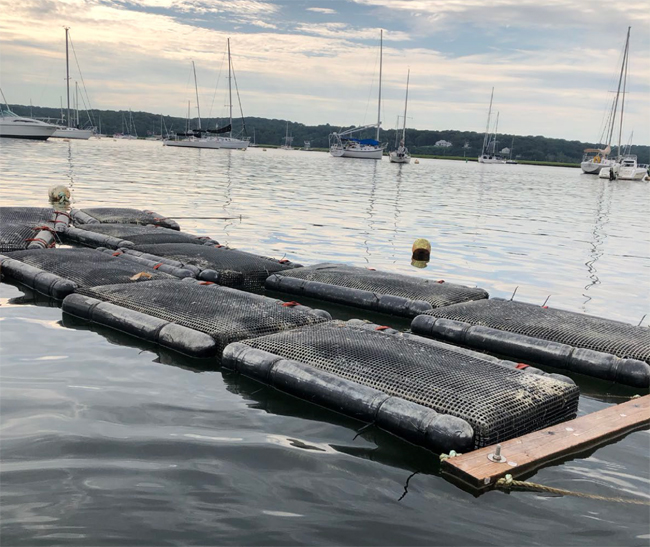
An array of aquaculture bags filled with Gracilaria in Northport Harbor. Credit: Christopher Gobler
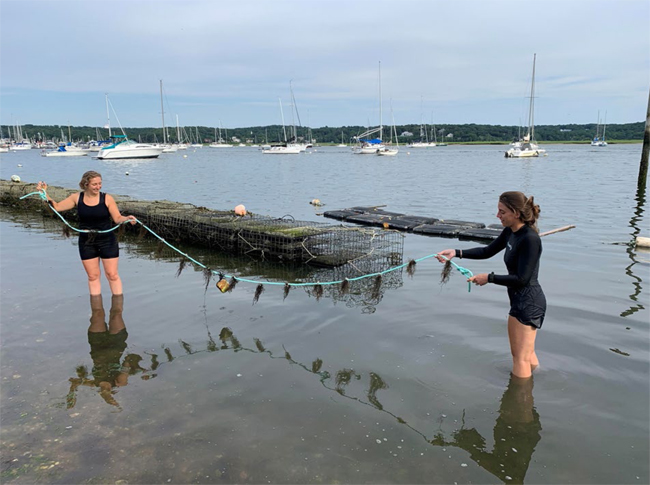
Clare Dana and Margot Eckstein with a line of Gracilaria in Mount Sinai Harbor. Credit: Christopher Gobler
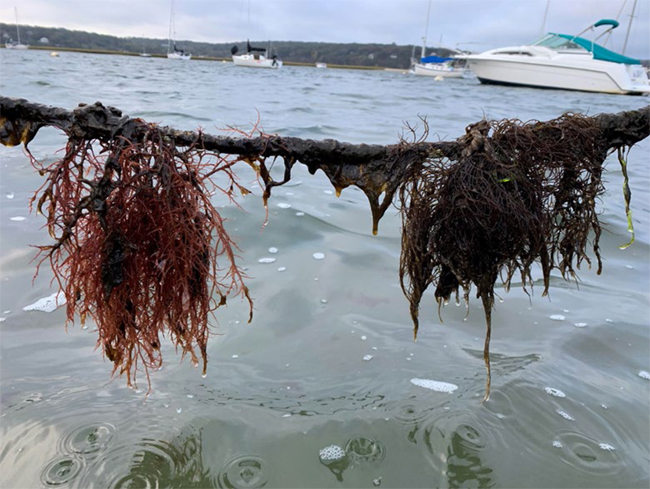
Gracilaria on a rope in Northport Harbor. Credit: Christopher Gobler
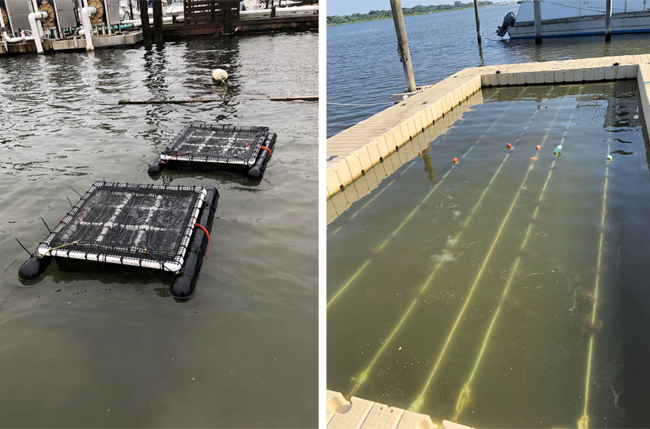
(at left) A novel experiment array used for a study with varieties of seaweed in Mount Sinai; (at right) A dock array experiment at the Stony Brook Southampton Marine Sciences Center. Credit: Christopher Gobler
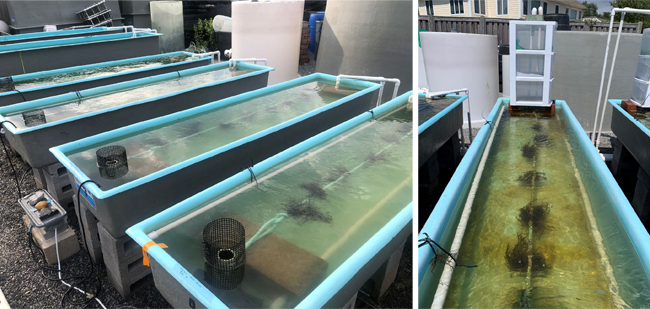
(at left) Flow-through seawater experiments at Stony Brook Southampton Marine Sciences Center; (at right) Flow-through seawater experiment. Credit: Christopher Gobler
More Info: New York Sea Grant
Established in 1966, the National Oceanic and Atmospheric Administration (NOAA)’s National Sea Grant College Program promotes the informed stewardship of coastal resources in 34 joint federal/state university-based programs in every U.S. coastal state (marine and Great Lakes) and Puerto Rico. The Sea Grant model has also inspired similar projects in the Pacific region, Korea and Indonesia.
Since 1971, New York Sea Grant (NYSG) has represented a statewide network of integrated research, education and extension services promoting coastal community economic vitality, environmental sustainability and citizen awareness and understanding about the State’s marine and Great Lakes resources.
NYSG historically leverages on average a 3 to 6-fold return on each invested federal dollar, annually. We benefit from this, as these resources are invested in Sea Grant staff and their work in communities right here in New York.
Through NYSG’s efforts, the combined talents of university scientists and extension specialists help develop and transfer science-based information to many coastal user groups—businesses and industries, federal, state and local government decision-makers and agency managers, educators, the media and the interested public.
New York Sea Grant, one of the largest of the state Sea Grant programs, is a cooperative program of the State University of New York (SUNY) and Cornell University. The program maintains Great Lakes offices at Cornell University, SUNY Buffalo, Rochester Institute of Technology, SUNY Oswego, the Wayne County Cooperative Extension office in Newark, and in Watertown. In the State's marine waters, NYSG has offices at Stony Brook University and with Cornell Cooperative Extension of Nassau County on Long Island, in Queens, at Brooklyn College, with Cornell Cooperative Extension in NYC, in Bronx, with Cornell Cooperative Extension of Ulster County in Kingston, and with Cornell Cooperative Extension of Westchester County in Elmsford.
For updates on Sea Grant activities: www.nyseagrant.org, follow us on social media (Facebook, Twitter/X, Instagram, Bluesky, LinkedIn, and YouTube). NYSG offers a free e-list sign up via www.nyseagrant.org/nycoastlines for its flagship publication, NY Coastlines/Currents, which it publishes 2-3 times a year.