This past summer, NYSG supported two CEI interns, both undergraduates at Stony Brook University, in gaining hands-on experience working with Long Island and NYC coasts and communities. Matthew Johnson and Rhianna Jackson reported back on their experiences, describing what their summer internships were like and their plans for the future.
— By Sumayyah Uddin, NYSG's Science Writer
Contact:
Kathy Bunting-Howarth, NYSG's Associate Director, E: keb264@cornell.edu, P: 607-255-2832
Stony Brook, NY, September 17, 2026 - Every year, New York Sea Grant’s Community Engaged Internship (CEI) supports undergraduate students in gaining hands-on experience working with coastal and marine communities — whether working closely with scientists and government partners or collecting and analyzing field data. Here, in their own words, 2026’s CEI interns reflect on their experiences in the program this past summer.
Rhianna Jackson
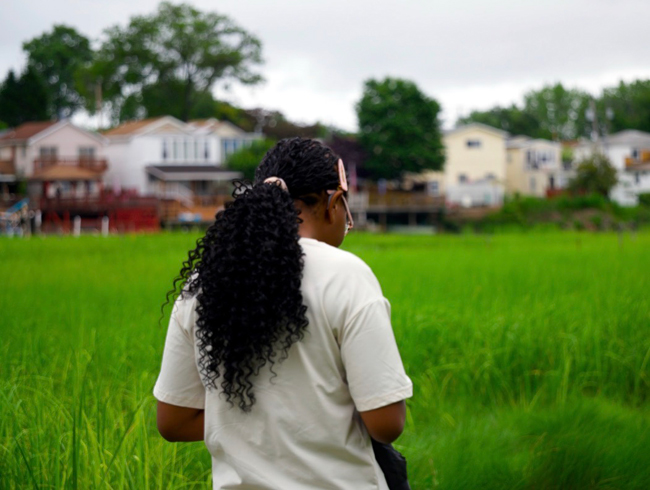
Rhianna visiting the salt marsh that the Natural Areas Conservancy planted at Soundview Park. Credit: Ivette Evangelista, 2026 NAC Intern
Rhianna Jackson is a Fall 2026 senior at Stony Brook University’s School of Marine and Atmospheric Sciences (SOMAS), where she majors in Environmental Design, Policy, and Planning. As a 2026 CEI Fellow, Rhianna worked on Natural and Nature Based Features monitoring, assisting with field work and educational outreach in the Long Island Sound Watershed [along the Long Island Coast shorelines in the Bronx and Queens].
In her own words:
My name is Rhianna, and this summer I had the opportunity to intern with New York Sea Grant as a CEI fellow. During this time, I focused on educational outreach about the Long Island Sound, living shoreline restoration, and data analysis. During the first half of the fellowship, I educated children about the Sound. My mentor and I spent time at Orchard Beach and City Island Oyster Reef, emphasizing to children the importance of a healthy and thriving estuary. We also used an Enviroscape model, which is used to demonstrate how water moves in a watershed. A highlight of the start of the summer was going horseshoe crab monitoring at 2 AM! Although the tide was too high to see any horseshoe crabs, the experience of being with other people as passionate about marine life as I am is one I will never forget.
Then, I began to have a heavier focus on Natural and Nature Based Features [along living shorelines along the Bronx River, a tributary of the Long Island Sound] as the summer progressed. I partnered with the Natural Areas Conservancy to conduct interviews with stakeholders involved in living shoreline restoration, where we asked questions about their intentions for each site. That way we could determine if a site was successful based on a stakeholders’ purpose for that specific project. While data collection can be tedious, this experience has helped me to fine tune my data analysis skills, my attention to detail, and, most importantly, my communication skills with a large variety of people and organizations. I am thankful that this experience has given me the opportunity to participate in hands-on work experience, which I will definitely use in my future career.
Matthew Johnson
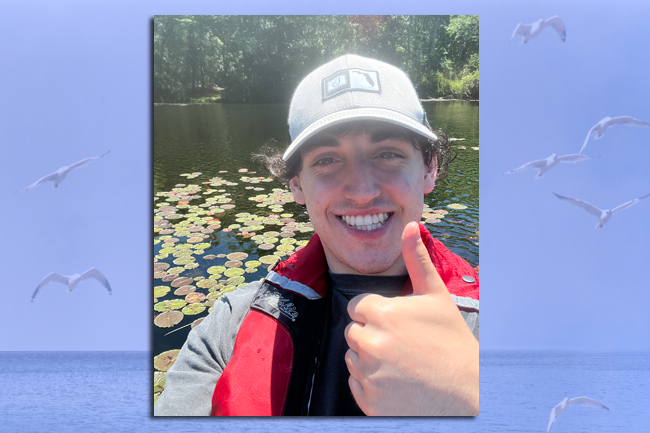
Matthew on a kayak at East Pond in Southampton, NY, as he begins drone sampling. Credit: Matthew Johnson
Matthew Johnson is a Fall 2026 senior at Stony Brook University’s School of Marine and Atmospheric Sciences (SOMAS), where he majors in Marine Science. As a 2026 CEI Fellow, Matthew worked as a Waterways Ambassador, assisting a community science group in monitoring freshwater systems for harmful algal blooms (HABs) while helping build a “HABs toolbox” for communicating hazards to the general public.
In his own words:
My name is Matthew Johnson, (and) I am currently a senior undergraduate working on a bachelor’s degree in Marine Science and minors in Political Science and Environmental Science. Working at Sea Grant under the CEI Fellowship Internship program has provided me with an insight into how the inner workings of fields related to marine science work, especially regarding topics such as HABs and their impact on both the environment and public health. Through this internship program, I have been exposed to fieldwork done regarding freshwater HABs monitoring and management, learning more about these types of HABs as well as what municipalities and public programs are involved with them, such as the NYDEC and the NY Department of Health and Suffolk County government.
Fieldwork days have involved visiting various freshwater ponds and creeks throughout the East End of Long Island, taking water samples and measuring water quality parameters such as DO (dissolved oxygen) and Chlorophyll-a content, and taking note on if a HAB may be visually present or not. By taking all (these) data, measurements, and samples, we have both been able to report HABs and gain insight into water quality in lesser-known freshwater systems in the local communities, which serves to strengthen the relationship between scientists and citizens. From this program, I have not only become more experienced in terms of fieldwork, but I have also learned more about the different opportunities available to me after graduation. This internship has helped me to progress towards my goals of working with freshwater and estuarine systems by highlighting what sort of topics are involved in such regions, and I hope to utilize these experiences to achieve a professional career in wetlands research and environmental health.
More Info: New York Sea Grant
New York Sea Grant (NYSG) is a university-based, statewide Federal-State collaboration between the State University of New York (SUNY), Cornell University, and the National Oceanic and Atmospheric Administration (NOAA). It is one of 34 university-based programs that connects research, extension, and education with the needs of coastal communities, environments, and economies through NOAA.
Since 1971, NYSG has supported science-based solutions for a wide range of water-related challenges and opportunities across the state. Through NYSG’s efforts, university scientists and extension specialists help develop and transfer science and technical information to educational institutions, businesses, agencies, and industries; federal, state and local governments; the media; and the interested public. The program is administratively based at Stony Brook University (SBU) and Cornell's College of Agriculture and Life Sciences (CALS).
NYSG historically leverages on average a 5.5-fold return on each invested federal dollar, annually. The State benefits from this, as these resources are invested in Sea Grant staff and their work in communities right here in New York.
New York Sea Grant, one of the largest of the state Sea Grant programs, maintains Great Lakes offices at Cornell University, SUNY Buffalo, Rochester Institute of Technology, SUNY Oswego, the Wayne County Cooperative Extension office in Newark, and in Watertown. In the State's marine waters, NYSG has offices at Stony Brook University and with Cornell Cooperative Extension of Nassau County on Long Island, in Queens, at Brooklyn College, with Cornell Cooperative Extension in NYC, in Bronx, with Cornell Cooperative Extension of Ulster County in Kingston, and with Cornell Cooperative Extension of Westchester County in Elmsford.
Established in 1966, the National Oceanic and Atmospheric Administration (NOAA)’s National Sea Grant College Program promotes the informed stewardship of coastal resources in 34 joint federal/state university-based programs in every U.S. coastal state (marine and Great Lakes) and Puerto Rico. The Sea Grant model has also inspired similar projects in the Pacific region, Korea and Indonesia.
For updates on Sea Grant activities: www.nyseagrant.org, follow us on social media (Facebook, Twitter/X, Instagram, Bluesky, LinkedIn, and YouTube). NYSG offers a free e-list sign up via www.nyseagrant.org/nycoastlines for its flagship publication, NY Coastlines/Currents, which it publishes quarterly.