A new suite of two-year research projects from New York Sea Grant features seven teams of investigators across four institutions in New York — Stony Brook University, Cornell University, SUNY College of Environmental Science and Forestry, and SUNY Oswego — exploring a range of stakeholder-driven topics to benefit residents in the State’s coastal region and beyond
Contacts:
Lane Smith, NYSG’s Research Program Coordinator, E: Lane.Smith@stonybrook.edu, P: (631) 632-9780
Sumayyah Uddin, Science Writer, NYSG, E: sumayyah.uddin@stonybrook.edu, P: (631) 632-6956
STONY BROOK, NY, June 1, 2026 — New York Sea Grant (NYSG) has awarded approximately $1.5M to support seven research projects addressing key community, environmental, and economic objectives for New York’s coastal areas and beyond.
The two-year projects that began on June 1st — administered by NYSG and funded through the National Oceanic and Atmospheric Administration (NOAA), Sea Grant’s federal parent agency — represent a range of stakeholder-driven topics. Research will be administered across several of New York’s coastal regions, including the Hudson, Great Lakes, and marine districts.
“For more than 50 years, NYSG has supported research projects that advance science-based knowledge and directly benefit New York’s coastal and marine communities,” said NYSG Director Dr. Becky Shuford. “These seven new exciting projects span a wide spectrum of topics both timely and relevant to New York residents, from long-term trends in native species populations and impacts from invasive species, to the potential economic and ecological outcomes of aquaculture activities, to emerging priorities such as novel approaches to mitigate PFAS contamination.”
The new projects include research to:
• Transform invasive bamboo into a sustainable remediation method for PFAS contamination on Long Island
• Assess the competition between wild and stocked juvenile salmon in the Great Lakes
• Evaluate forty years of PFAS in the Hudson River Estuary
• Determine whether invasive mussels are impeding lake trout restoration in the Great Lakes
• Evaluate and optimize a 1-year bay scallop aquaculture production cycle
• Examine changes in spatial structure of native and invasive fish species in the Hudson River Estuary
• Investigate long-term trends in mysid shrimp abundance and spatial distribution across Lake Ontario using historical acoustic survey data
Five NYSG Scholar Fellows — graduate students who will work on these projects under the mentorship of the Principal Investigators (PIs) — will be participating in the research, gaining essential skills as they become the next generation of scientists, decision-makers, educators, and environmental stewards.
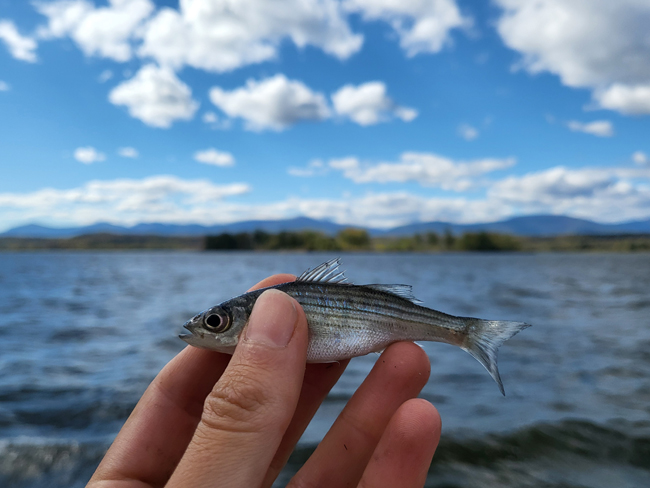
A researcher from the Chen Lab of Fisheries Science and Management at Stony Brook University holds a juvenile striped bass against the Hudson River in NY. A research team backed by NYSG seeks to create models to quantify and predict habitat change by examining interactions between invasive and native fish species. Credit: Natalia Castro
Quantifying Spatial-Temporal Dynamics of Suitable Habitats for Key Native and Invasive Fish Species in A Changing Hudson River Estuary to Inform Management
Lead PI: Dr. Yunzhou Li, Stony Brook University
Co-PI: Dr. Yong Chen, Stony Brook University
Federal Funds: $238,224
Estuarine ecosystems like the Hudson River Estuary (HRE) face many stressors, ranging from invasive non-native species to rising temperatures. One particular threat comes from invasive species such as zebra mussels, which impact the food web and nutrient cycling and disrupt native species’ abundance, growth, and distribution. Less studied are the impacts of non-native fish species on native fishes. This project aims to examine and categorize interactions between similar invasive fish species and native fish species and identify key environmental drivers influencing habitat use and spatial distribution within the HRE. Expected results are the eventual development of models to quantify and predict habitat suitability and biogeographic changes over time and space.
“Compared to the well-known zebra mussel invasion, the impacts of invasive fish species in the HRE are relatively understudied due to a lack of long-term monitoring data,” explained Yunzhou Li, Research Scientist at Stony Brook University’s (SBU) School of Marine and Atmospheric Sciences (SoMAS). “By analyzing long-term shifts in the habitat use and biogeography of both native and invasive fishes, this project will identify the environmental and biological drivers that shape species distribution across time and space, which remains a major knowledge gap for managers.”
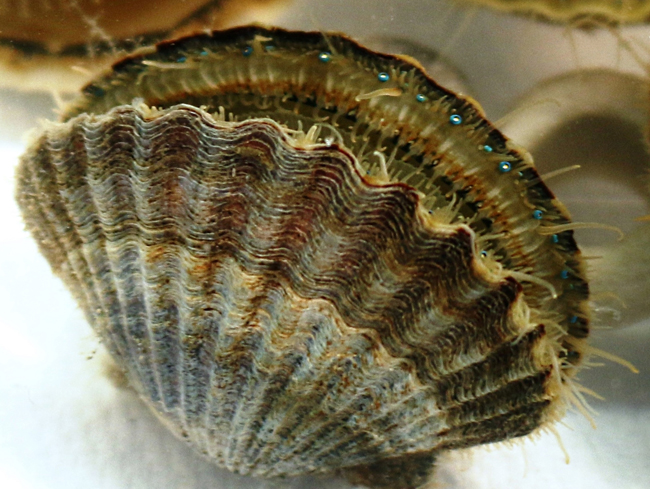
Adult bay scallop (Argopecten irradians) set up for an experiment evaluating the effect of temperature on disease development and mortality. A NYSG-supported research project is attempting to use a strain of disease-resistant bay scallops to build a scallop aquaculture industry. Credit: Bassem Allam
Optimization of Bay Scallop Aquaculture in New York To Promote Farm Diversification and Resilience
Lead PI: Dr. Bassem Allam, Stony Brook University
Co-PI: Dr. Emmanuelle Pales Espinosa, Stony Brook University
Federal Funds: $239,984
Bay scallops, which have a long history in New York, have long supported a vibrant Long Island-based fishery. However, mass die-offs since summer 2019 have devastated the industry, impacting local baymen and the economy and causing scallop prices to spike. This project proposes using a strain of disease-resistant bay scallops developed through prior research to build a scallop aquaculture industry in New York. The project is based on China’s aquaculture success story, in which a small number of scallops introduced in the 1980s have now become a thriving business due to a short production cycle. Researchers are attempting to replicate the production cycle with the new scallop strain for similar results.
“We hope to demonstrate the feasibility of a 1-year bay scallop production cycle in New York, empowering shellfish growers to diversify their production and have a supplemental income,” said Bassem Allam, Marinetics Endowed Professor in Marine Sciences at Stony Brook University (SBU)’s School of Marine and Atmospheric Sciences (SoMAS). “Shellfish aquaculture is a sustainable, environmentally friendly activity that supplies the domestic market with highly needed products. As such, it is important to explore various avenues to support food security.”

Dr. Lokesh Padhye pictured at work in his lab at Stony Brook University. Dr. Padhye is part of a NYSG-supported research team engineering bamboo biochar for use in adsorbing PFAS. Credit: Lokesh Padhye
Transforming Invasive Bamboo Into a Sustainable Solution for PFAS Remediation in Long Island’s Contaminated Groundwater
Lead PI: Dr. Lokesh Padhye, Stony Brook University
Co-PI: Dr. Christopher Gobler, Stony Brook University
Federal Funds: $238,114
Contaminated groundwater on Long Island may be responsible for transporting per- and polyfluoroalkyl substances (PFAS) into coastal waters. PFAS in coastal areas can impair water quality, pose exposure risks, and threaten aquatic ecosystems. Since conventional treatment approaches are costly and operationally challenging for low-level PFAS contaminants, researchers propose using invasive bamboo to produce a sustainable biochar to remove PFAS from contaminated groundwater. To do so, researchers plan to engineer bamboo biochar that can adsorb PFAS and can be used in permeable groundwater treatment systems. This material will then undergo laboratory characterization, column testing, and field evaluation to assess its performance once deployed.
“This is not just an academic exercise in creating a new material; it is a practical effort to protect Long Island’s drinking water and coastal ecosystems by leveraging resources already available in the region and providing a viable alternative or complement to conventional, but expensive, granular activated carbon (GAC) and ion exchange (IX) resin treatment,” said Lokesh Padhye, Associate Professor at SBU’s SOMAS and Associate Director of Emerging Contaminant Research at New York State Center for Clean Water Technology. “We can transform an invasive plant that many homeowners and towns are struggling to manage into a tool for cleaning up ‘forever chemicals’ in groundwater. If successful, the approach we develop here could be adapted for use in other regions and with other waste biomasses, helping communities turn local environmental problems into part of the solution.”
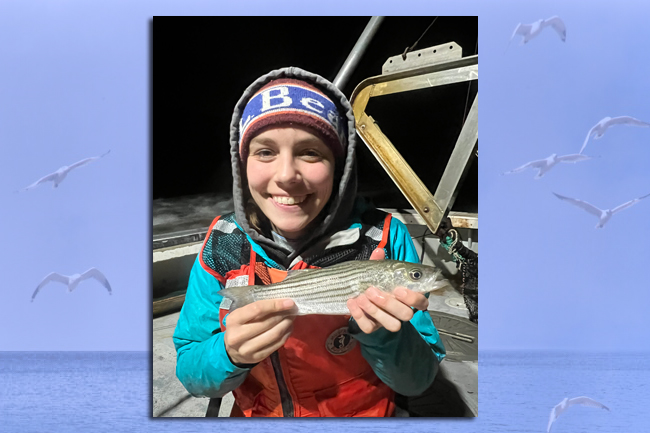
(L) Sarah Praisner, a PhD candidate in Dr. Yong Chen’s lab at Stony Brook University, holds a striped bass collected from the Hudson River Estuary. A NYSG-supported team is investigating PFAS prevalence in the area by analyzing striped bass scales. Credit: Natalia Castro
Tracking Forty Years of PFAS Prevalence in The Hudson River Estuary
Lead PI: Dr. Oliver Shipley, Stony Brook University
Co-PI: Dr. Lokesh Padhye, Stony Brook University
Federal Funds: $239,122
Per- and polyfluoroalkyl substances (PFAS) comprise a family of contaminants that negatively impact biota, including humans. Through this project, researchers plan to develop a historical time series of PFAS prevalence in one area in particular, the Hudson River Estuary (HRE). The research team will analyze PFAS effects in the HRE by analyzing protein extracted from striped bass scales collected over forty years through the Hudson River Biological Monitoring Program. This study intends to use results to inform next steps for fisheries management, consumption advisors, and stewardship of the HRE.
“PFAS exposure in humans has been of growing concern over the last decade, especially given that some compounds have been linked to chronic disease such as cancers. We hope to identify PFAS that are of emerging concern to seafood consumers by constructing a 40 year record of their concentrations in the Hudson River,” said Oliver Shipley, Research Scientist at Stony Brook University’s (SBU) School of Marine and Atmospheric Sciences (SoMAS). “It is extremely challenging to track historical prevalence of PFAS over the last several decades, because the samples required to do this simply do not exist. With the powerful archive of the Hudson River Biological Monitoring program, we are able to assess historical trajectories of PFAS at unprecedented resolution, and determine how declines and increases in some compounds have responded to regulatory changes. Sampling of modern fishes will provide important insight into emerging PFAS that could be of human health concerns to seafood consumers.”
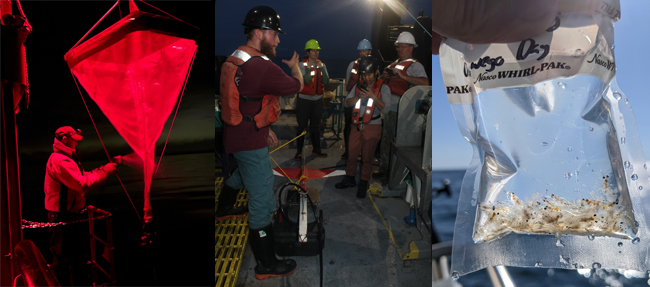
(L to R) Kayden Nasworthy, a graduate student at Cornell University, sampling mysid shrimp with a net; teaching a class of teachers on R/V Lake Guardian in 2023; and holding a bag of collected mysids. A new NYSG-funded research project is evaluating long-term trends in mysid shrimp populations in Lake Ontario. Credit: Kayden Nasworthy
Evaluating Mysid Abundance in Lake Ontario Using Two Decades of Fisheries Acoustics Data
Lead PI: Dr. James Watkins, Cornell University
Co-PI: Dr. Kade Keranen, Cornell University
Federal Funds: $239,996
Mysid shrimp are small crustaceans that are an important component of Lake Ontario food webs. Mysid shrimp have historically made up around 30% of the zooplankton in Lake Ontario, serving as both a predator for smaller zooplankton and a primary prey source for fish. However, recent decades show a deteriorating shrimp population in some lakes, which may potentially have negative impacts on the wider food web. This project seeks to use trawl-acoustic data from the past two decades to evaluate long-term trends in mysid shrimp population abundance. This will help researchers determine this zooplankton’s distribution, understand more about the factors impacting abundance, and explore potential avenues for future management.
“We are hoping to gain a better understanding of the processes driving mysid densities in Lake Ontario, and what may be different in Lake Ontario compared to other Great Lakes such as Lake Michigan with declining mysid populations,” explained James Watkins, Associate Director of Cornell Biological Field Station and Senior Research Associate in Cornell’s Natural Resources and the Environment section. “...Even small shrimp-like crustaceans are vitally important to the offshore Great Lakes food web, and a better understanding of what is influencing mysid densities can inform how managers reintroduce native fish species such as cisco (Coregonus artedi) and bloater (Coregonus hoyi).”
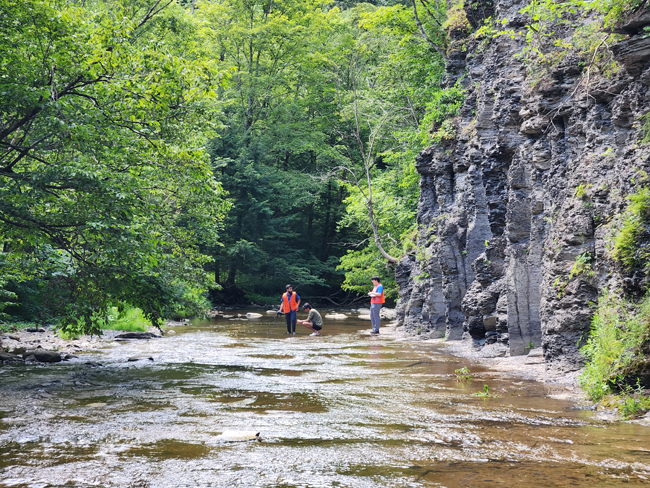
SUNY ESF students collect water in Limestone Creek, NY, to analyze in the lab for carbonate chemistry. A NYSG-funded research team is using similar water sampling methods in a project examining how invasive mussels harm spawning lake trout. Credit: Aaron Ninokawa
Are Dreissenid Mussels Impeding Lake Trout Restoration in Lake Ontario?
Lead PI: Dr. Aaron Ninokawa, SUNY College of Environmental Science and Forestry
Co-PI: Dr. Jennifer Goff, SUNY College of Environmental Science and Forestry
Federal Funds: $170,493
New York State fisheries are a crucial part of the state’s economy, generating up to $2.1 million each year and supporting thousands of jobs. Reliance on certain species, however, can cause problems with their long-term viability. Lake Ontario fisheries rely on native lake trout, but wild reproduction has been suffering due to many challenges, including those posed by invasive Dreissenid mussels (such as quagga mussels). This research project will evaluate the ways that invasive mussels harm the spawning habitats of lake trout by conducting both field tests and lab experiments. Results will hopefully yield new options for habitat management and restoration to improve the prospects of the lake trout stock.
“We will test whether mussels and their associated microbial communities can change the chemistry experienced by lake trout embryos. These early stages of lake trout are a bottleneck in their life cycles and we hope to better characterize conditions that might impair their survival,” explained Aaron Ninokawa, Assistant Professor in the Department of Chemistry at SUNY ESF. “Our goal is to determine whether the lake trout populations can be limited by chemical modifications within mussel aggregations.”
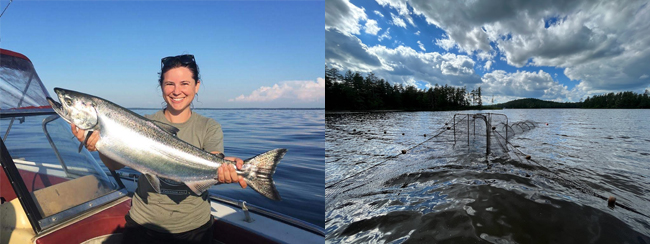
(L) Dr. Ellen Karboski holds an adult Chinook caught on Lake Ontario; (R) A fyke net set by Dr. Ellen Karboski and her students in the Adirondacks in 2022. Dr. Karboski and a NYSG-funded research team are working to assess the competition between stocked and wild salmon in Lake Ontario. Credit: Ellen Karboski
Wild and Stocked Juvenile Salmon Abundance in Nearshore Areas of Lake Ontario
Lead PI: Dr. Ellen Karboski, SUNY Oswego
Co-PI: Dr. Nicholas Sard, SUNY Oswego
Federal Funds: $138,342
Pacific salmon represents the most popular recreational fishery on Lake Ontario, returning approximately $500M to the New York State economy in 2019. While salmon numbers are managed through careful stocking to maintain a balance between salmon and their preferred prey, the proportion of hatchery fish in this area is now less than 50%, weakening the fisheries’ main lever of control over the population. This project will use seining, in-stream fyke nets, and electrofishing to collect and quantify juvenile salmon, assess the competition between stocked and wild salmon, and collect data to guide future management and restoration.
“Chinook and coho salmon are popular sport fish in Lake Ontario, and return approximately half a billion dollars to the New York state economy every year through license fees, gear sales, and travel expenditures. Currently, Chinook and coho salmon population numbers in the lake are managed through stocking. However, salmon are successfully reproducing in tributaries along the eastern shore of Lake Ontario, and about half of all adult salmon caught in the lake are of wild origin,” said Ellen Karboski, Assistant Professor in the Biological Sciences Department at SUNY Oswego. “In our project, we will begin a nearshore seining index survey to try and quantify the number of wild-produced smolts emerging from eastern Lake Ontario tributaries. We are also developing a new, low-impact net design to sample out-migrating smolts in the small rivers and streams along the eastern shore of the lake.”
More Info: New York Sea Grant
New York Sea Grant (NYSG) is a university-based, statewide Federal-State collaboration between the State University of New York (SUNY), Cornell University, and the National Oceanic and Atmospheric Administration (NOAA). It is one of 34 university-based programs that connects research, extension, and education with the needs of coastal communities, environments, and economies through NOAA.
Since 1971, NYSG has supported science-based solutions for a wide range of water-related challenges and opportunities across the state. Through NYSG’s efforts, university scientists and extension specialists help develop and transfer science and technical information to educational institutions, businesses, agencies, and industries; federal, state and local governments; the media; and the interested public. The program is administratively based at Stony Brook University (SBU) and Cornell's College of Agriculture and Life Sciences (CALS).
NYSG historically leverages on average a 5.5-fold return on each invested federal dollar, annually. The State benefits from this, as these resources are invested in Sea Grant staff and their work in communities right here in New York.
New York Sea Grant, one of the largest of the state Sea Grant programs, maintains Great Lakes offices at Cornell University, SUNY Buffalo, Rochester Institute of Technology, SUNY Oswego, the Wayne County Cooperative Extension office in Newark, and in Watertown. In the State's marine waters, NYSG has offices at Stony Brook University and with Cornell Cooperative Extension of Nassau County on Long Island, in Queens, at Brooklyn College, with Cornell Cooperative Extension in NYC, in Bronx, with Cornell Cooperative Extension of Ulster County in Kingston, and with Cornell Cooperative Extension of Westchester County in Elmsford.
Established in 1966, the National Oceanic and Atmospheric Administration (NOAA)’s National Sea Grant College Program promotes the informed stewardship of coastal resources in 34 joint federal/state university-based programs in every U.S. coastal state (marine and Great Lakes) and Puerto Rico. The Sea Grant model has also inspired similar projects in the Pacific region, Korea and Indonesia.
For updates on Sea Grant activities: www.nyseagrant.org, follow us on social media (Facebook, Twitter/X, Instagram, Bluesky, LinkedIn, and YouTube). NYSG offers a free e-list sign up via www.nyseagrant.org/nycoastlines for its flagship publication, NY Coastlines/Currents, which it publishes quarterly.